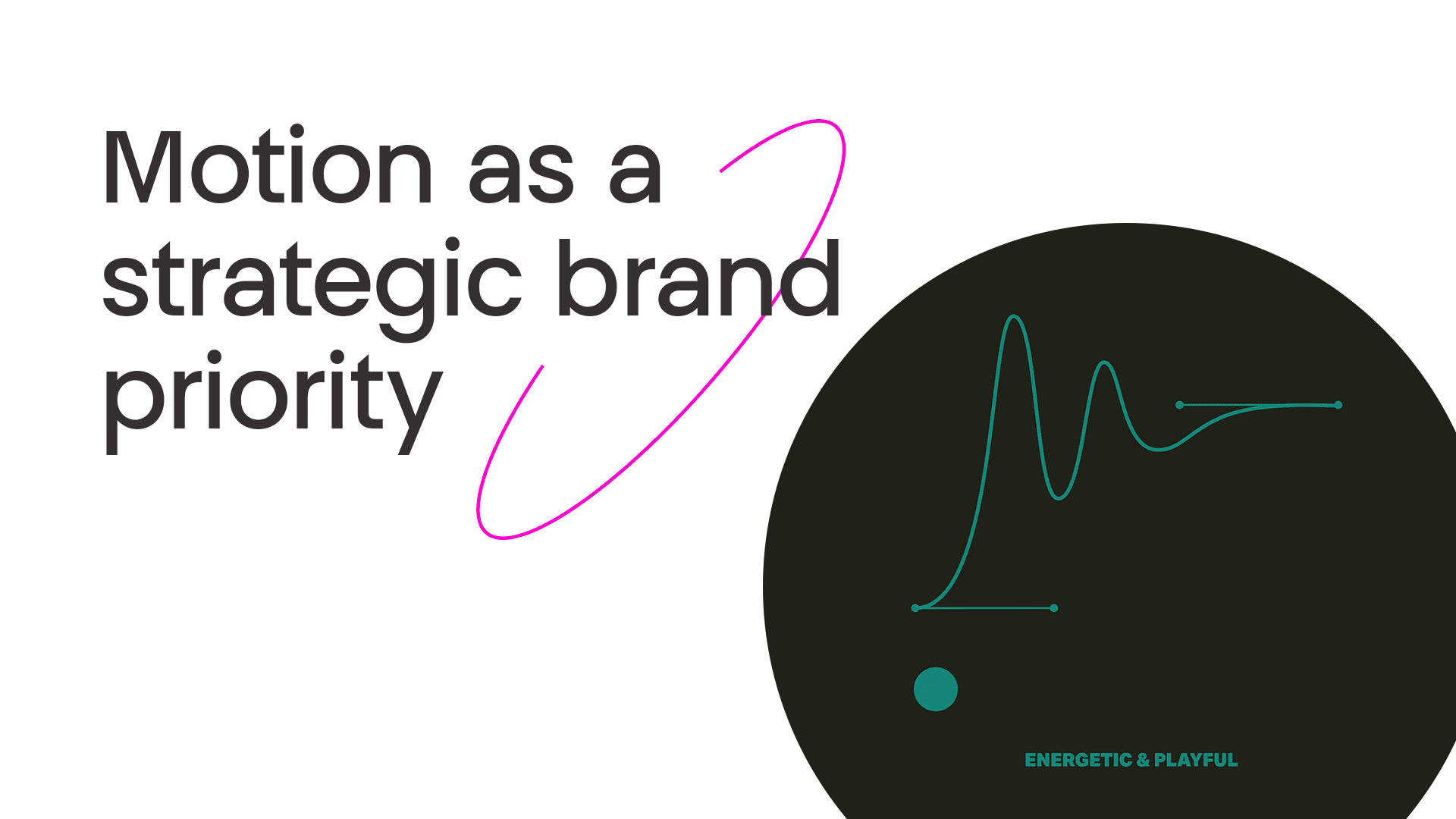
Why Motion is Now a Strategic Business Priority (Not an Afterthought)

For years, motion has been treated as a finishing touch. Something added once the brand identity is signed off, the campaign is locked, or the product is already built.
An animated logo at the end of a video. A few transitions for social. A hero moment for a launch.
That approach no longer holds up.
In a world where brands are experienced primarily through screens, motion is not an embellishment. It’s a core part of how brands communicate, behave and perform.
Brands now live in motion-first environments
Audiences today encounter brands in environments defined by movement. Feeds scroll. Interfaces respond. Content auto-plays. Attention is fleeting and competition is constant.
Static identities were never designed for this reality. They struggle to communicate hierarchy, intent and personality at the speed digital platforms demand.
Motion solves that problem by adding a temporal layer to brand expression. It gives brands control over how messages appear, when attention is guided and what moments matter most.
This is not about trends. It’s about relevance.
Motion shapes perception before words do
Movement is processed instinctively. Before we read copy or interpret visuals, we register motion. Speed, rhythm and flow all influence how something feels before we consciously understand what it is.
That makes motion one of the most powerful tools brands have for shaping perception.
Confident brands move with clarity and intent. Calm brands give space and breathing room. Energetic brands create momentum. These signals are communicated in milliseconds, often without the audience realising why something feels right.
When motion is missing or inconsistent, those signals break down.
From attention to clarity
Motion isn’t just about attracting attention. It plays a practical role in helping people make sense of what they’re seeing.
Well-designed movement helps audiences understand relationships, priority and change. It guides the eye, signals what matters and makes complex information easier to follow.
In product experiences, motion provides feedback and reassurance. In brand communications, it helps control pace and structure. In both cases, it reduces friction rather than adding to it.
This is where motion moves beyond aesthetics and starts to earn its place.
The cost of treating motion as an add-on
When motion is added late in the process, it becomes reactive. Designers are forced to animate static assets never designed to move. Developers bolt on interactions without a clear behavioural logic. Campaigns rely on bespoke solutions that can’t be reused.
The result is inconsistency, inefficiency and diluted brand impact.
More importantly, opportunities are missed. Motion becomes decorative rather than meaningful, and brands fail to use one of their most effective tools to differentiate and connect.
Motion as strategic infrastructure
Treating motion as a strategic priority changes how brands operate.
Instead of isolated animations, brands invest in motion systems that define behaviour across touchpoints. Instead of one-off executions, motion becomes a repeatable, scalable asset. Instead of visual noise, movement becomes a clear and recognisable part of brand identity.
This shift allows motion to support long-term goals, from brand recognition and experience design to operational efficiency and speed to market.
Tell us about your project
Back to top